



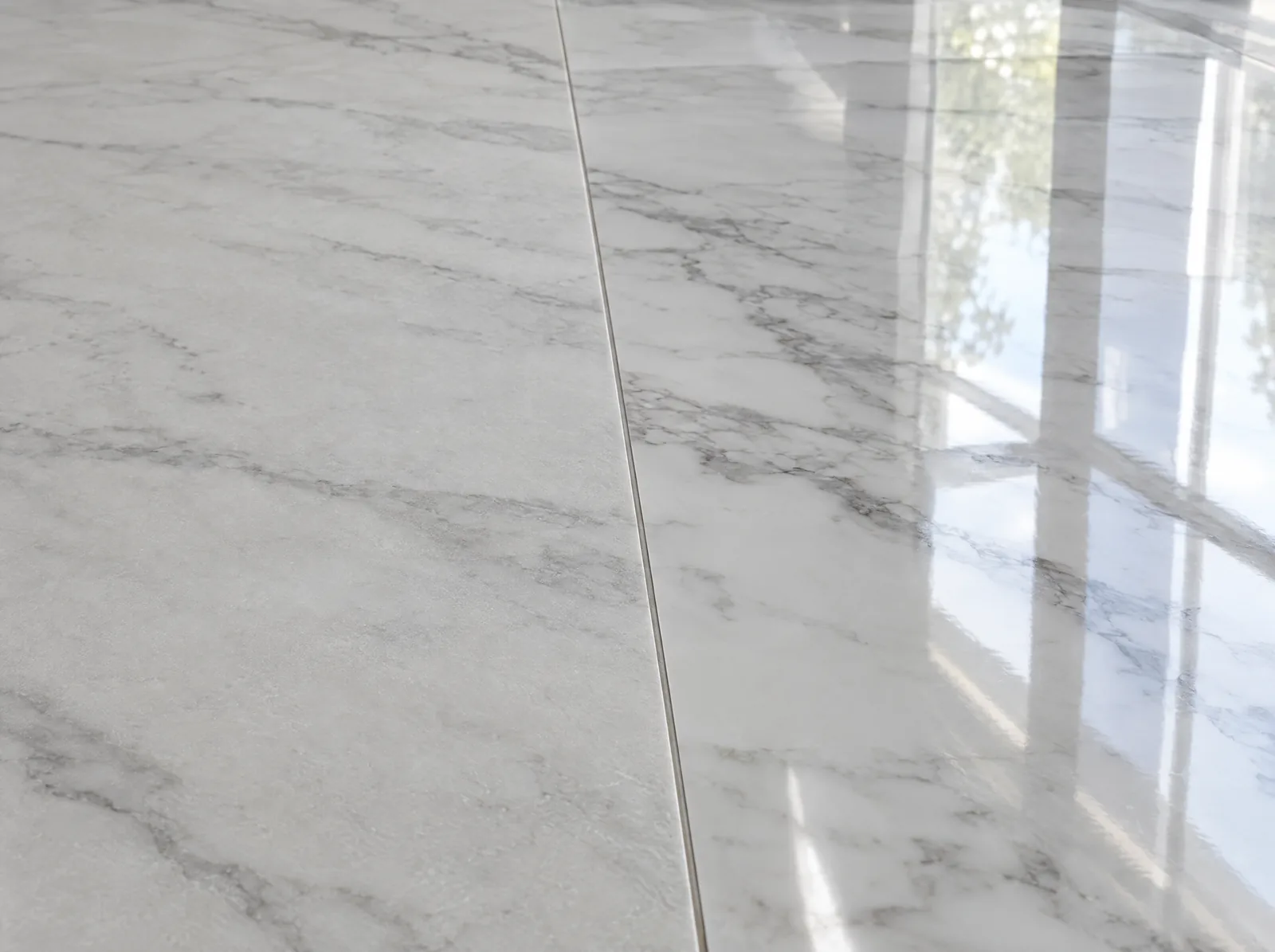
What the difference actually is
Both finishes are created with abrasives. Marble is ground flat, then refined with progressively finer diamond abrasives. Stop partway through that sequence and the surface is honed: smooth to the touch, with a matte or soft satin look. Continue through the finest stages and polish, and the surface becomes reflective.
Neither finish is a coating. The finish is the stone itself, which is why it can be restored and why it can also be changed. It also means a sealer does not create the shine. Penetrating sealers sit below the surface to slow staining; they do not decide which finish you have.
How each one looks
Polishing deepens color and sharpens contrast, so the veining in a white or gray marble reads crisply and darker marbles look richer. A polished floor bounces light around a room and has a formal, finished quality that suits grand entries and traditional interiors.
A honed finish is quieter. Colors look slightly lighter and softer, veining is more muted, and the floor has a calm, natural feel that works in relaxed and contemporary interiors as well as older homes. Many people find honed marble more forgiving visually, since it does not mirror every footprint, lamp and window.
Slip resistance, etching and scratches
Polished marble is noticeably more slippery when wet. A honed surface has more microscopic texture for a foot to grip, which is why it is generally preferred in bathrooms, kitchens and anywhere water is likely to reach the floor. Neither finish should be treated as non-slip when wet, and bath mats and prompt drying still matter.
Etching works the same way on both. Marble is mostly calcium carbonate, and acids from citrus, wine, vinegar, tomato and many household cleaners react with it chemically. On polished marble the result is an obvious dull spot in a shiny field. On honed marble the same etch is still there, but it blends into the matte surface and is much harder to see. Fine scratches follow the same pattern: they catch the light on polished stone and largely disappear on honed.
- Polished: reflective, deeper color, formal look. Shows etching and scratches. Slicker when wet.
- Honed: matte to satin, softer color, relaxed look. Hides etching and scratches. Better traction when wet.
Maintenance differences
Daily care is the same for both finishes. Dust mop with a clean, untreated dry mop or vacuum with a soft head to remove grit, damp mop with a pH-neutral cleaner made for stone, and blot spills promptly. Keep vinegar, lemon, bleach, ammonia and abrasive powders off either finish.
Polished floors tend to need professional refreshing sooner in busy areas, because the dulling from traffic and etching is obvious. Honed floors hide that wear, but their surface is slightly more open, so they can hold dirt in the texture and absorb spills a little more readily. Keeping a honed floor sealed and cleaned regularly matters. Both finishes benefit from a penetrating sealer, which slows staining but does not stop etching.
Which rooms suit which finish
Many homes end up with both finishes, and that is a reasonable plan rather than a compromise. The general rule is simple: the more water, food, grit and traffic a room sees, the more a honed finish makes sense.
- Formal entries, living and dining rooms: polished works well where traffic is moderate and water is rare.
- Kitchens: honed or satin, because spills, splashes and acidic foods are constant.
- Bathrooms and laundry rooms: honed, for traction when wet and to hide etching from toiletries and cleaners.
- Mudrooms and doors to patios or pools: honed, since grit and water arrive together.
- Powder rooms, studies and bedrooms: either, depending on the look you want.
Converting from one finish to the other
Because the finish is mechanical, a floor can be changed. Converting polished to honed means honing the surface back to a chosen grit with diamond abrasives, which removes the polish along with existing etching and fine scratches. Converting honed to polished means continuing through finer abrasives and a final polishing stage.
A few cautions apply. Not every marble takes a high polish equally well, and some limestones and travertines are better left honed, so a test area is worth doing first. A whole room should be converted at once so the sheen is even, and the transition into adjoining rooms should land at a doorway or threshold. The floor should be resealed after conversion. Finally, look at the test area in daylight and at night before committing, because lighting changes how both finishes read.
When to call a professional
Day-to-day care is something any homeowner can handle. Changing a finish, or restoring one that has worn unevenly, is not a do-it-yourself job: it takes diamond abrasives, careful water management and experience reading how a particular stone responds. Call a professional when you are considering a switch between finishes, when traffic lanes or etching have made the floor patchy, or when you want to see both finishes on your own stone before deciding.
Grout Geek offers free on-site and photo-based estimates across Ventura, Santa Barbara and the Conejo Valley, and every job is backed by our make-it-right guarantee: if any area is not right, we come back and fix it at no charge. Call (805) 628-2011.
Updated 2026-09-30 by the Grout Geek team.