



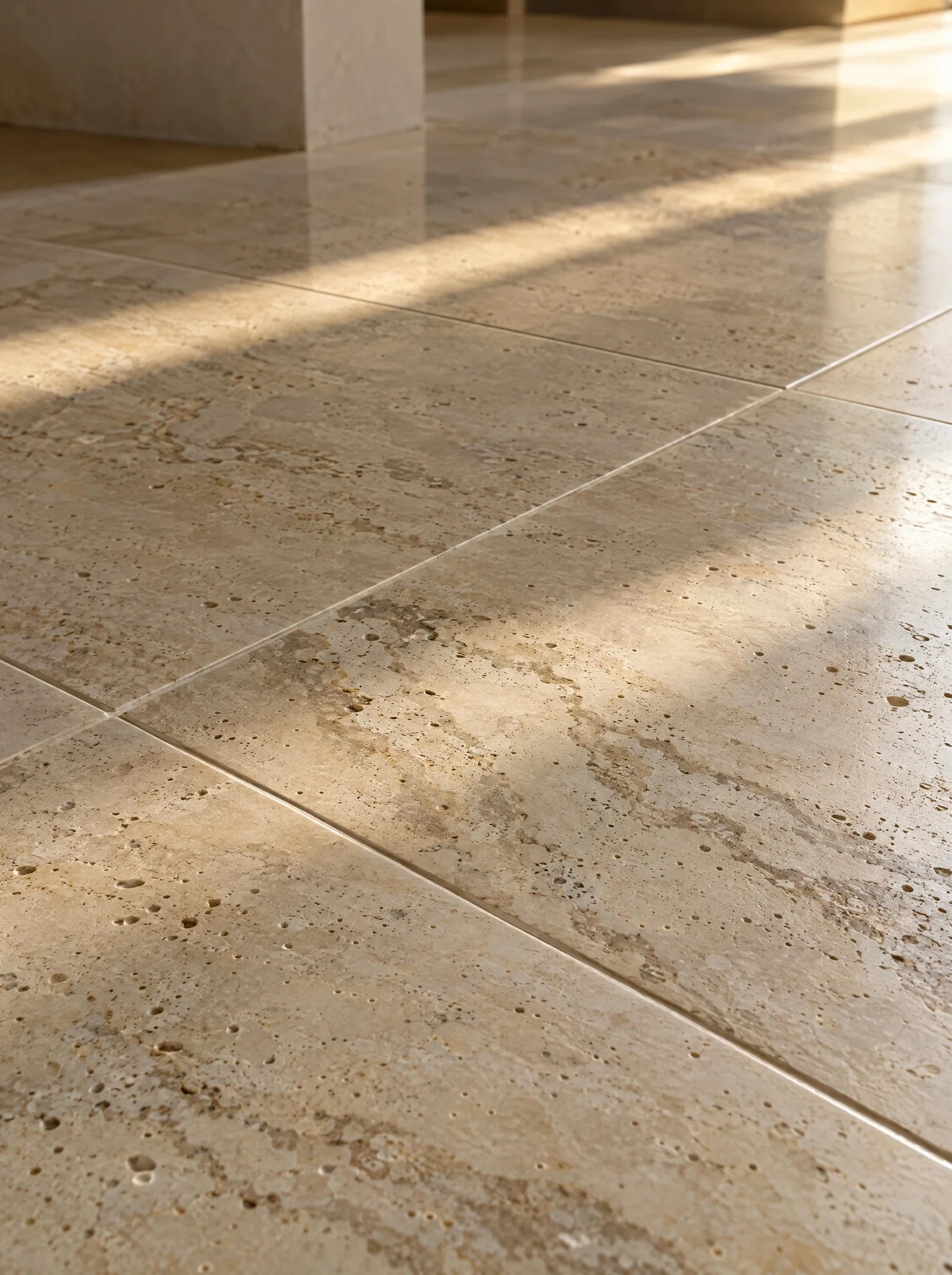
Why travertine needs a careful approach
Travertine forms from calcium carbonate deposited by mineral springs. That chemistry makes it acid-sensitive: vinegar, lemon and many common cleaners react with the surface and leave dull etch marks. Its natural voids, which are usually filled at the factory on floor tile, also need some care, because harsh cleaning and heat can loosen that fill over time.
Most travertine floors are honed, a smooth matte finish, though some are polished and some are tumbled, with a textured, rustic surface. The routine below works for all three.
Daily and weekly routine
Grit is the main cause of wear on travertine floors, so removing sand and soil dry matters more than how often you wet mop. Treated dust mops can leave residue on stone; a plain dry mop is safer. For wet cleaning, use a cleaner labeled pH-neutral and safe for natural stone, or a small amount of mild dish soap in warm water, which the Natural Stone Institute lists as an acceptable option. Rinse afterward, because soap left on the floor builds into a dull film.
- Daily, or whenever grit is visible: dust mop with a clean, untreated dry mop, or vacuum with a soft brush head and no beater bar.
- Weekly: damp mop with warm water and a pH-neutral stone cleaner, diluted as directed.
- Wring the mop well. The floor should be damp, not wet, and should dry within a few minutes.
- Change the rinse water often so you are not spreading dirty water back over the floor.
- If streaks appear, buff dry with a soft cotton or microfiber towel.
What to avoid
Most damage to travertine comes from well-intended cleaning. Read the label on anything that promises shine or disinfection, since many multipurpose and bathroom products contain acids or strong alkalis. Keep these off the floor:
- Vinegar, lemon, citrus cleaners and anything acidic. They etch travertine on contact.
- Bleach. It is harsh and strongly alkaline, can break down sealers and discolor grout and fill, and is not for routine floor cleaning. Never mix it with ammonia.
- Ammonia and ammonia-based glass or all-purpose cleaners. Repeated use can dull the surface and degrade sealers.
- Abrasive powders, scrubbing creams and scouring pads, which scratch the finish.
- Steam mops. Heat and moisture can break down sealers, drive water into the stone and loosen factory fill. Check with a stone professional before using one.
- Oil soaps and wax-based floor products, which leave buildup that traps dirt and dulls honed stone.
- Rubber-backed rugs left in place for long periods, which can trap moisture against the floor.
Grout lines
Grout between travertine tiles is usually cement-based and porous, so it darkens with soil long before the stone looks dirty. Clean it with the same pH-neutral cleaner and a soft nylon brush. Avoid acidic grout cleaners and stiff wire brushes, since anything strong enough to attack the grout will also attack the travertine beside it.
If grout stays dark after cleaning, it needs professional extraction cleaning and resealing, or grout color sealing, which coats each joint in a uniform color and makes it far easier to keep clean.
Mats, spills and holes
Put mats outside and inside every exterior door and shake them out often. Felt pads under chairs and furniture prevent scratches. Blot spills right away rather than wiping, which spreads them, then rinse the spot with clean water.
Small holes appear in travertine floors over time as factory fill wears or pops loose. They are not a sign of a failing floor, but they collect dirt and their edges can chip. Vacuum them out rather than letting debris pack in, and skip off-the-shelf fillers that do not match the stone, which can look worse than the hole. A professional fills them with a color-matched filler and hones it flush with the surface.
Testing whether it needs resealing
A penetrating sealer slows stain absorption; it does not stop etching. To check whether yours is still working, put a small puddle of water on a few spots, including a busy traffic lane and a quiet corner. Wait about 10 to 15 minutes, then wipe it up.
If the stone underneath has darkened, water is soaking in and the floor is due for resealing. If it stays the same color, the sealer is still doing its job. Floors in kitchens, entries and bathrooms usually need resealing sooner than bedrooms and formal rooms. Always clean the floor and let it dry completely before sealing.
When to call a professional
Routine cleaning is easy to handle yourself. Call a professional when etch marks or traffic lanes have dulled the floor, when holes are opening up across the floor, when grout stays dark after cleaning, when the water test shows the stone absorbing quickly, or when you are not sure what finish or sealer is already on the floor.
Grout Geek restores travertine across Ventura, Santa Barbara and the Conejo Valley with color-matched hole filling, diamond honing and polishing, and penetrating sealers. Estimates are free, on-site or from photos, and every job is backed by our make-it-right guarantee. Call (805) 628-2011.
Updated 2026-09-30 by the Grout Geek team.