



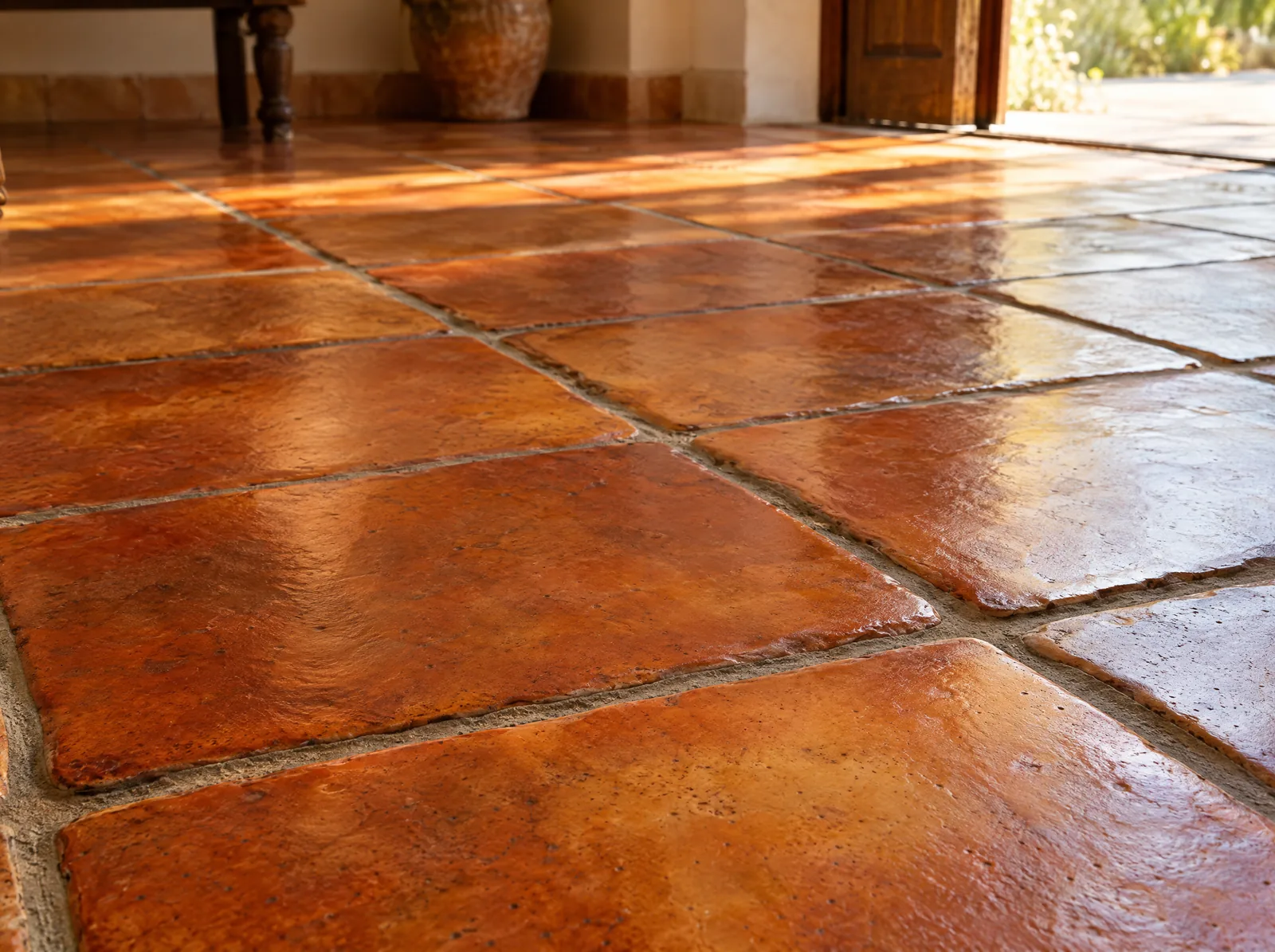
What makes Saltillo different
Saltillo tile is made from clay found around Saltillo, in Coahuila, Mexico. It is shaped, dried in the open air and fired at relatively low temperatures, which leaves a soft, unglazed, very porous tile with natural color variation and irregular edges. Unsealed, it soaks up water, oil and dirt quickly.
That is why Saltillo is almost always sealed, and why caring for it is mostly about managing the sealer system rather than the clay itself.
Topical vs penetrating sealers
Penetrating sealers, sometimes called impregnators, soak into the clay and work below the surface. They reduce absorption without changing the look much, allow the tile to breathe, and do not peel or wear off as a film. On their own they leave a natural, matte appearance.
Topical sealers and finishes, including waxes and acrylic-type coatings, form a film on the surface. They give Saltillo its familiar satin or glossy look and take the wear instead of the tile. The tradeoffs are that films wear unevenly in traffic lanes, can yellow with age and can trap moisture underneath.
Many Saltillo floors use both: a penetrating sealer to protect the clay, then topical coats for sheen and a sacrificial wear layer. Knowing which type is on your floor determines how you clean it and how it will eventually need to be renewed.
- Penetrating: works below the surface, natural matte look, breathable, little visible wear.
- Topical: a film on the surface, adds sheen, wears in traffic lanes, needs maintenance coats and eventual stripping.
What causes white haze
A white, milky or cloudy look on Saltillo has a few common causes, and the right fix depends on which one you have. Residue sitting on the surface can sometimes be cleaned off. Haze within or under a topical coating generally means the finish has to come off so the tile can dry out before it is resealed with a breathable system. Efflorescence should be removed dry, with a brush or vacuum, because water simply dissolves the salts and they return as the floor dries.
- Moisture trapped under a topical finish, from tile sealed before it was fully dry or water working under a worn coating. This is the most common cause.
- Efflorescence: mineral salts carried up through the clay or grout by moisture and left on the surface as a white powder or crust.
- Buildup of wax, finish or cleaner residue, which clouds as layers accumulate.
- Sealer applied too heavily or in damp conditions, which can dry cloudy.
Signs the floor needs stripping
Topical finishes eventually reach a point where another coat makes things worse. Stripping removes the old finish chemically, along with the dirt embedded in it, so the floor can be resealed from a clean start. These are the signs it is time:
- Yellow, amber or orange discoloration from aged finish.
- Haze or cloudiness that does not clean off.
- Peeling, flaking or a sticky surface.
- Dark dirt trapped in the coating, especially in corners and along baseboards.
- Bare, dull traffic lanes next to glossy, built-up edges.
- Water soaking in and darkening the tile in worn areas.
How often to reseal
There is no single schedule. A floor with a topical finish needs a light maintenance coat when its traffic lanes begin to dull, which comes around much sooner in a busy kitchen or entry than in a quiet bedroom. Applied before the finish wears through, these coats push back the day the floor needs a full strip.
For floors protected by a penetrating sealer alone, use a water test. Place a small puddle of water in a busy area and a quiet one and wait 10 to 15 minutes. If the clay darkens, the sealer is no longer holding and it is time to reseal. Whatever you apply, make sure the tile is clean and completely dry first, since sealing over moisture is how many hazy floors begin.
Everyday cleaning and the right products
Dust mop or vacuum often, because grit wears through topical finishes quickly. Damp mop with a pH-neutral cleaner diluted as directed, using a well-wrung mop, and avoid flooding the floor, since standing water can work into grout lines and under worn finish. Use this as a quick product guide:
- Use a pH-neutral cleaner suitable for sealed tile, and clean water to rinse.
- Avoid vinegar and other acids, which attack cement grout and can damage some finishes.
- Avoid ammonia and strong alkaline degreasers, which soften and strip wax and acrylic finishes.
- Avoid oil soaps and mop-and-shine products, which build up and cloud.
- Avoid steam mops, which push heat and moisture into porous clay and finishes.
- Use mats at exterior doors and felt pads under furniture.
When to call a professional
Routine cleaning and occasional maintenance coats are manageable for most homeowners. Stripping is a different job. It involves chemical strippers, careful extraction, protecting walls and adjoining floors, and patience while the tile dries, and mistakes such as sealing over damp clay are behind many hazy floors. Call a professional when the floor shows the stripping signs above, when haze keeps coming back, when you are not sure what is on the floor, or when you want a specific sheen.
Grout Geek strips and reseals Saltillo and terracotta throughout Ventura, Santa Barbara and the Conejo Valley, removing failed finishes while preserving the patina. Estimates are free, on-site or from photos, and every job is backed by our make-it-right guarantee. Call (805) 628-2011.
Updated 2026-09-30 by the Grout Geek team.